Although pre-germination of the both dry and wet rice varieties was not popular, it was particularly advantageous for wet rice varieties as it ensured that seeds would sprout rather than waiting for them to cultivate under water that may be too deep or too muddy. Before germinated seeds would be soaked to tell what ones were empty and should be discarded. Seeds would be soaked in a two gallon bucket, one gallon of water and salt (120 ounces of salt for ordinar, 100 for glutinous). Salt and water mixture would be stirred with a bamboo brush until salt is dissolved and after dissolved 4-5 pints of rice would be added. Empty kernels would float to the top and skimmed off the top with bamboo. After no more floaters were found the rice would be drained and put into another bucket to wash away the salt
After rice was washed, the seeds would be soaked for 5 nights then drained and put into a et grass basket where then they would be kept warm and damp. After 3 nights they would begin to shoot. Although the seeds may be able to germinate in the paddies themselves, pre-germination also had other advantages outside of muggy or deep waters. Pre-germination helped accelerate the growth process of the rice and helped the rice compete better with weeds that may grow in the paddy. (Bray, 1984, 248)
In research we discovered that weather in relation to rice farming varies. Specific events such as weather and season impact the planting and harvesting of rice fields. In the southern regions of China in the Qing Dynasty farmers began to plant crops in the spring and harvested in the fall. In this specific region there was not a lot of rain fall or flooding that took place. However, there were intense summers, and the winter season was warmer. The moister and the general weather from the southern regions of China allowed more valuable crops, specifically rice. In the winter crops were planted in what was referred to as the lunar 9th and 10th months, and then harvested in Hsiao-man. Hsiao-man is a time around the end of May. However, for different types of rice there was a more widespread timeframe due to the fact that most were transplanted in the lunar 5th month (many-Chang, or June) and then harvested in the 8th or 9th months (Liu 1989,1-16). It is important to note that these times varied based on rice type and other conditions. It was also known that several droughts took place during the Qing dynasty and these changes impacted the yield, quality, and sowing period (Lin et al.2020). Moreover, regions near the Yangtze farmers have a shorter sowing window due to the heat. These patterns can still be observed in modern day rice farming.
The house in our build is offset away from the irrigation network for two reasons. The first is to minimize the potential for water contamination that could negatively affect the crop’s yield were the water to be polluted. The second is to center the home closer to the road for easy travel between the home and other areas. The rice paddie is thus secluded to a closed system where it can be tended to by the tenant family. (Knapp 2019)
For the purposes of our build, the focus of research and presentation takes place outside the home where rice cultivation occurs. The majority of the home is thus closed off to viewers except for the courtyard and storage that were involved in the processes of rice cultivation for tools and other related activities on the farm. (Knapp 2019)
Materials
The Siheyuan style, recognized by its 4 outter walls and single entry courtyard layout, was still popular in this period for its versatility and simplicity. Houses across various social strata could thus adopt this framework while utilizing vernacular resources and materials. In the Hubei region where our farm is placed, wood and clay brick continues to be common fixtures in rural homes for their accessibility and growing affordability among the masses. Our buildings utilize these resources in housing both this individual family and their communal grain stores. (Knapp 2019)
In research we discovered that weather in relation to rice farming varies. Specific events such as weather and season impact the planting and harvesting of rice fields. In the southern regions of China in the Qing Dynasty farmers began to plant crops in the spring and harvested in the fall. In this specific region there was not a lot of rain fall or flooding that took place. However, there were intense summers, and the winter season was warmer. The moister and the general weather from the southern regions of China allowed more valuable crops, specifically rice. In the winter crops were planted in what was referred to as the lunar 9th and 10th months, and then harvested in Hsiao-man. Hsiao-man is a time around the end of May. However, for different types of rice there was a more widespread timeframe due to the fact that most were transplanted in the lunar 5th month (many-Chang, or June) and then harvested in the 8th or 9th months. It is important to note that these times varied based on rice type and other conditions. It was also known that several droughts took place during the Qing dynasty and these changes impacted the yield, quality, and sowing period. Moreover, regions near the Yangtze farmers have a shorter sowing window due to the heat. These patterns can still be observed in modern day rice farming.
The Yangtze River is essential in China, contributing to over half of China’s fish and rice industries. The Yangtze River is known for its freshwater and rich soil surrounding the river, which makes it a hot spot for farmers. One popular rice farming region is known as the Jianghan Plain, which lies within the southern part of Hubei Province. The plain was formed by the alluvial deposits of the Yangtze River (Feng et. al, 2023). It has low-lying and flat wetlands that are mainly used for farming, particularly rice farming, due to its rich soils. Because of its location on the Yangtze River its soils are particularly rich due to the sediments carried by the river. (Feng et. al, 2023)
This region is a significant source of rice production in China and is known to grow two types of wet rice varieties, Indica and Japonica. Both rice come in different glutinous, sticky, and non-glutinous varieties and have been known to be farmed. Our farmers primarily used Indica. (Bray, 1984)
Tenant farmers under the Qing period experienced a multitude of both reforms and revivals of taxation and rent payment. As many tenant farmers would be lifted from legal serfdom under their landlords at the outset of the 1820s, pre existing fees and taxes would be leveraged in-kind via rents to landlords. While landlords could no longer extort services from their tenants, they could affect taxes and payment adjacent to municipal bureaucratic structures (Theobald, 2000). Tenants likewise during this period would gradually begin to pay these rents and taxes in quota-based fees rather than paying lords through their services. Contracts would reflect this new relationship in the tenant’s right to work their own land so long as they paid their quotas until the contract’s end.
In terms of land use itself, parcels of land were often divided up into small plots that could be worked by a collective of 1-4 households where the landlord would retain a larger parcel for their own use (Marks, 1996). This divvying up of the land was attributed to the nature of rice cultivation and the pressures of growing urban environments and geographical constrictions. With land being a constraint and rice being a labor intensive crop, rice farmers could better maximize their yields within a small area of land by paying close attention to each rice plant in their fields. Thus, it was more advantageous for any landlord, be they an owner or lower subletter of rented lands, to keep their best fields for their use while renting out smaller plots to other families. Families of 10-15 people could reliably nurture their rice paddies and send payment to their renter in the form of rice crop quotas or monies.
The rice trade in the Qin dynasty was massive, stretching across the empire and involving deep interplay between the Qin state and a commercialized economy. The state bought up rice from provinces with rich harvests and transported it to provinces with low harvests to keep prices down. The state also bought up rice to keep in grain reserves in case of emergencies, spread throughout the empire. There were networks where rice-rich provinces along the Yangtze River would transport their rice to provinces with drier climates. Rice was transported both through the river networks and by sea between coastal provinces. However, at some points, coastal trade was restricted due to fear of piracy and smuggling. The state gave merchants tax exemptions to transport rice to famine-struck areas during crises. Overall, the state and merchants both used shipping, mainly through the rivers and the Grand Canal, to move rice from the provinces that produced it to the less fertile parts of the country in what were parallel and interconnected systems. This meant that rice grown in Zhejiang, such as in our paddy, would likely find its way across the empire before being eaten. This trade prevented localized famines throughout the empire, though it was not always successful. These systems began breaking down later in the Qin dynasty, and so more local famines took place around the era we are looking at in the late 19th to early 20th centuries. (Hao, Danyang, and Jingyun 2021)
Fertilizer Economy
Although the presence of alluvial soil grants our region’s family less of a dependence on traditional fertilizer, acquiring supplemental fertilizers was normal practice. During the production of bean-curd (or tofu), there was a considerable amount of waste left behind, and due to leguminous plants’ efficacy as a green manure, this waste was compacted into dry wheels (known as oil cakes) and sold to farmers for use as fertilizer (Bray 1984). In use, the wheels are pounded into a powder and applied to the soil. Due to the beans’ high fertility efficiency, one cake could fertilize an entire mu of rice. (Bray 1984, 289-318)
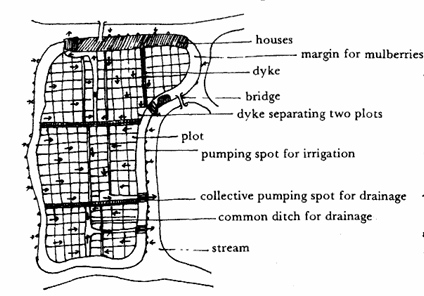
One common field type in the lower Yangtze region is poldered fields or dyked fields called Yu Thien. Typically, these fields are built upon reclaimed wetlands used to create arable lands, which are common in low-lying plains. Small dykes using the dirt and clay from the surrounding lands would be built around rice paddies as a way to prevent flooding and be used as a marker to divide fields. These dykes could be used as walkways for farmers to reach fields and sometimes small bridge-like structures made of wood would also be built on the dykes used to get from field to field with ease. (Bray, 1984, 118-119)
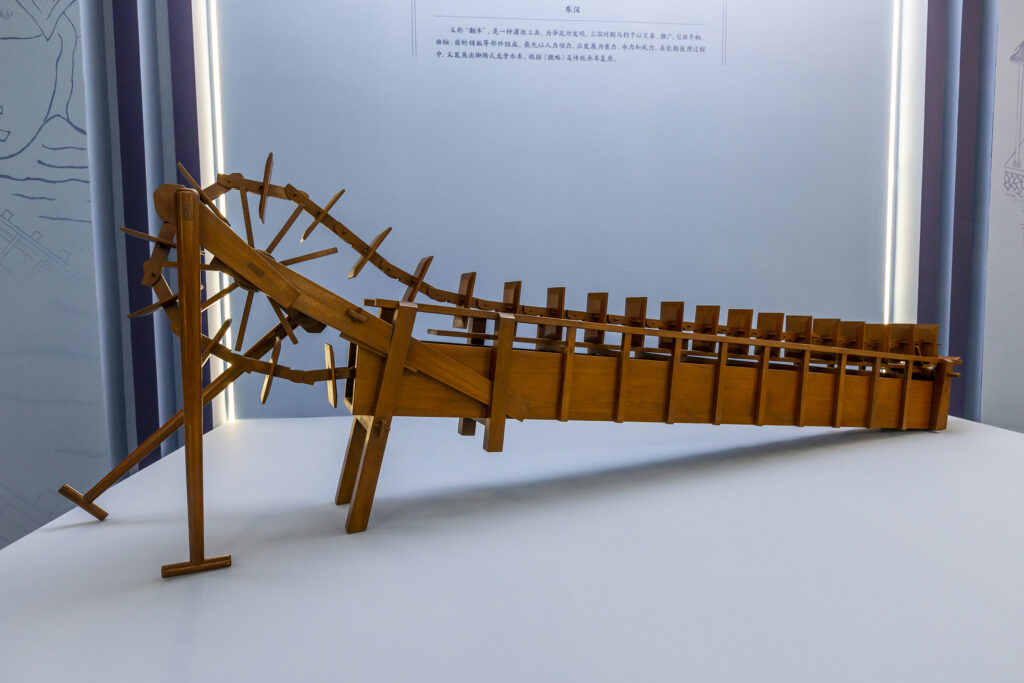
Each field would be divided into smaller plots to create paddies. The fields the harder it was to supply water to water to inner fields, so drainage ditches provided support to flooding inner paddies as well as giving a drainage system during rainier seasons. To fill this drainage ditch with the outside river, a square-pallet chain pump, also known as the dragon backbone pump, would be used to raise water into the inner paddies. The pump was made out of bamboo and wood and would often be man-powered by hand or animal, depending on the size of the pump and the land. The water is lifted through wooden troughs on the pumping system, and axles are attached to both ends. The axles connect a chain with blades to both sides of the trough. When the trough is placed in water, its handlebars are rotated causing the blades on the chain to rotate, pumping up water. (Zong, 2023). The pump would often be a mobile system that could be moved from the river-stream connection to paddies that needed to be re-flooded. (Zong, 2023)Clean water was necessary for fields of rice to thrive, and as such, drainage ditches were dug out at the farthest point upstream and drained downstream. Nursery paddies were prioritized and needed the cleanest water to ensure a proper start to the growth process, so nursery paddies would be the closest to the cleanest point of water access. Proper flooding techniques also helped to maintain the growth of weeds, as some weeds are unable to grow in continuous flooding and certain depths. Early rice stages were usually planted in an inch of water and later grown in as much as six inches once transplanted from nursery fields (How to Grow Rice: Planting, Care, & Harvesting Practices). It is another priority that irrigated fields need to be leveled, and as such, it was common for them to be on valley floors allowing easier control of the amount of water in each paddy. Fields outside urban sectors were much smaller and compact, making proper irrigation necessary for the quality management of the fields. Poorer farms did not have the funds or necessary labor-reducing tools to maintain and regulate fields and systems (Bray, 1984, 118-119)
There were three variations of granaries depending on how they were run in this era. Normal Granaries, known as Changpingcang, were originally intended for military supply; they eventually became the state’s tool to balance harvest fluctuations. Charity Granaries, called Yicang, were set up for local famine relief. Rice was gathered directly as a tax rather than being purchased by the state. Community Granaries, known as Shecang, were locally managed and were created due to state mismanagement and failures of the other granaries, allowing local leaders to organize reserves independently. We depict a community granary in our build. By the time we are depicting the normal state granary system has failed in the aftermath of the taping rebellion. It should be noted that our granary would be used by a whole area with numerous paddies like ours donating to it. All three granary types would use the common cang design only varying in scale. (Will et al. 1991, 1-16)
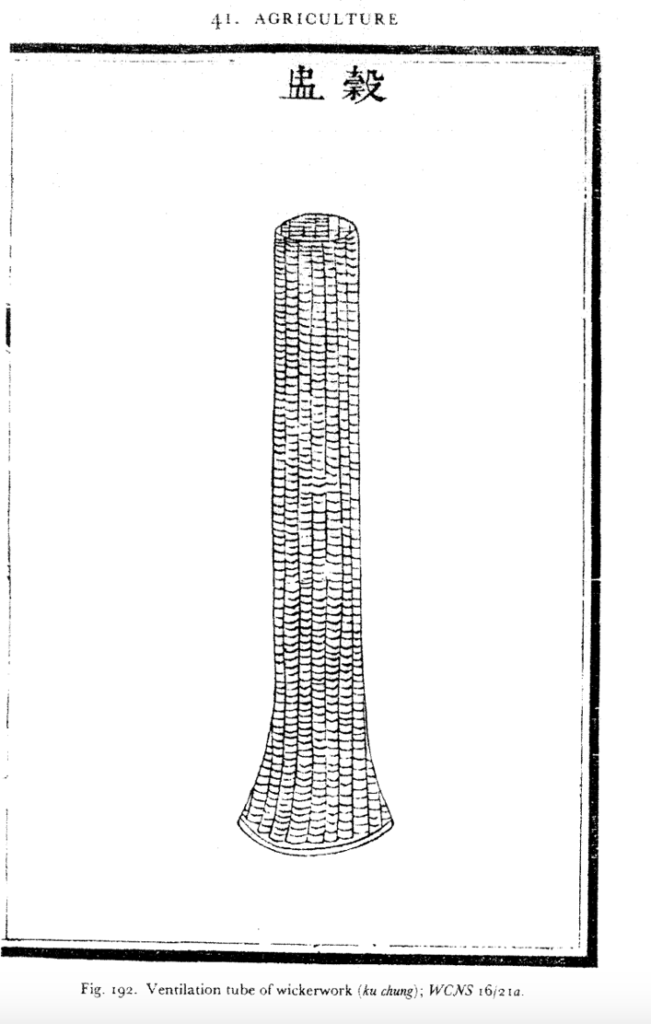
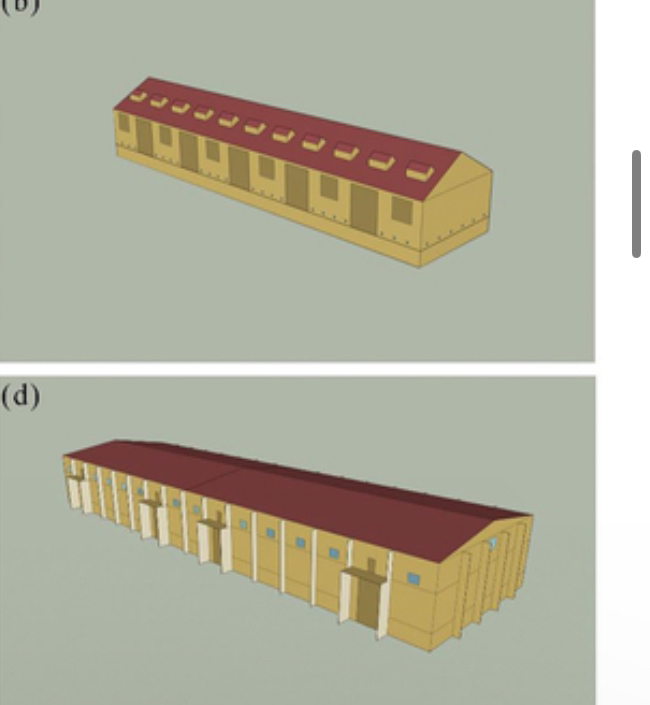
The cang-style granary was a rectangular building constructed to have brick walls reinforced by iron fastenings, with a coating of plaster against dampness. Added internal layers of planks and mats were installed to serve effectively as absorbents of moisture. The bases of granaries were normally of stone slabs or tamped earth, with layers of coal ash, wheat chaff, bricks, planks, and matting on top to prevent moisture from the ground seeping into the grain. Roofs were multilayered for insulation, comprising beams covered with planks, bamboo frames, a layer of earth, and tightly fitted tiles on the outside. In such a combination, heat insulation could be obtained, and extreme changes in temperature could be controlled, both critical for grain preservation. The qilou, or roof lanterns, were large structures placed on the roof to allow warm air to rise and escape, regulating the building’s temperature and humidity. Smaller bamboo cylinders, called qitong, were inserted vertically into the grain to channel humid vapors upward, preventing moisture buildup within the grain. In more humid regions of China, ventilation windows with fine work called fengchuang allowed air to enter and leave but kept out pests such as birds. These windows, along with other small wall openings at ground level, controlled moisture and ground vapors that might otherwise compromise grain quality. Granaries were typically divided into multiple bays called jian, which were separated by wooden partitions. It was a common practice to leave one bay empty and shift the rice between the pods, to promote cooling and airing. (Will et al. 1991, 103-140 )
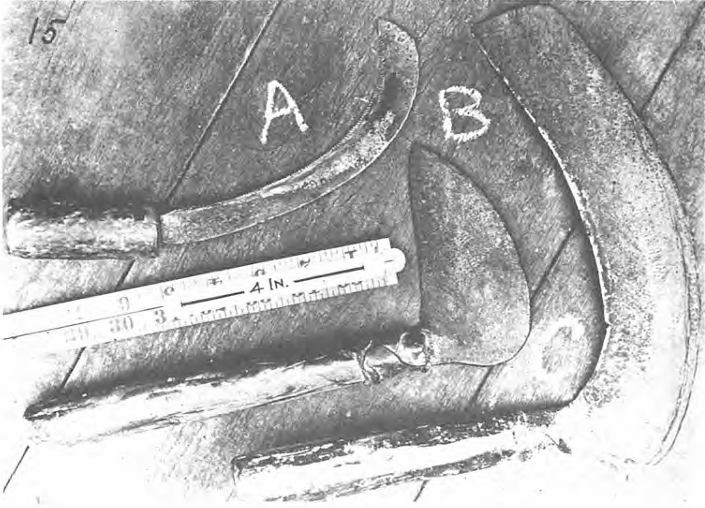
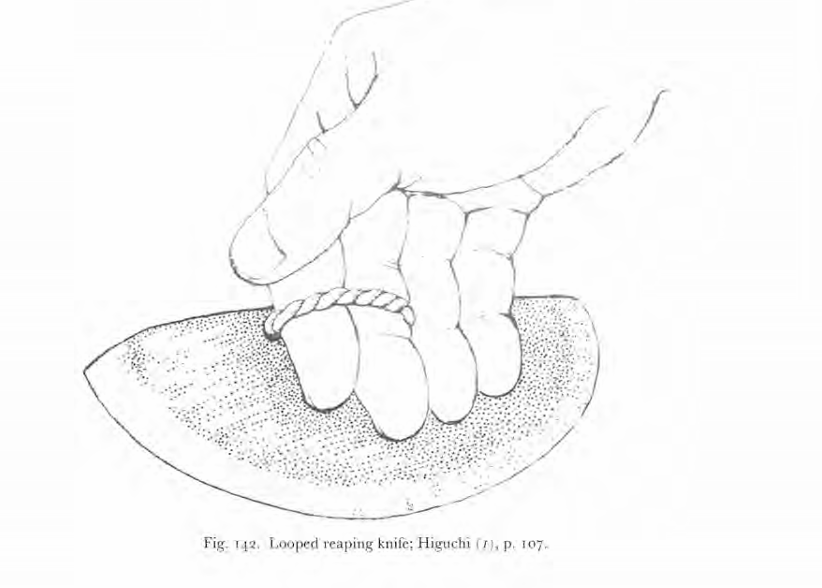
Rice is typically harvested around 3-6 months after being planted usually in September or October (Jones, 1927, 86). Early harvesting was typically done by hand using a variety of tools. One tool that was used to harvest rice was called the harvesting knives. Harvesting knives are typically made of stone, shell, or even pottery and much later was known to have been made out of iron. This object was hand-held and took various different shapes. Typically this object could be held in the palm of the hand with a loop of cord, leather, or metal that fingers could pass through. These knives were ideal for reaping crops that ripen uneavely. It allowed for careful inspection of each head of grain and facilitates their development and ripeness (Bray, 1984, 329). These knives have been known to be used as early as neolithic times and are still used today,
Another popular reaping tool for rice was the sickle also known as “lien”. Early sickles were known to made of stone or shell and later made of bronze or iron. Sickles took on various shapes the most popular being a balanced Sickle which would be heavily curved and set so that it extends behind the handle as well as in fron, balancing the weight around the handle so its less tiring to use (Bray, 1984, 331). Balanced Sickles are less common in China but there is no rational to explain. Unbalanced sickles were usually gently curved with a thick ridge along the back for strength and a smooth blade. The blade was typically 20-30 CM long. Sickles were used to harvest large quantities of a grain and serrated sickles were most popular to use in rice growing areas as they could could withstand this humidity in rice growing regions.
Only one mechanised reaping tool called a push-sickle (thui lien) was known to be used later own which could be associated to be a primitive lawn mower. Chinese farmer failed to develop mechanical tools for reaping. It is speculated that because terrain of fields and sizes made it unnecessary to have any sort of mechanised tools.e (Bray, 1984, 336)
(Bray, 1984 333)
(Bray, 1984, 326)
Threshing
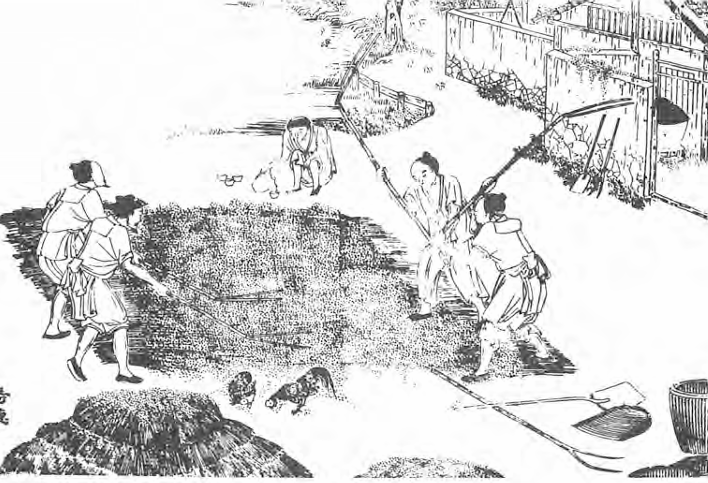
Before storing threshing was required to remove grain from the straw. There were a few tools used to thresh the seed which included threshing floors, tubs and sticks. Threshing floors were a more permanent structure made of a mixture of sand, lime, and cement that made it impervious to rain with proper care. To substitute permanent flooring, these floorings were substituted by a finely woven mat. Mat not only avoided grains from being contaminated with dust or sand but also prevented losses. The mat may be used for sun-drying the grains or rol,ed up to make a cylindrical basket (thun). Threshing tubs would be made out of bamboo and would be either rounded or square. (Bray,1984, 347) Threshing the seed could either be done by hand or removed by being treaded upon. Treading required the use of ones own feet, animal, or heavy roller. To be less injurious to feet grain would be treaded upon while still damp. Treading the seed was usually a womens task. Another form of threshing would be to beat out the shieves, this could either be done by hand or with the use of a flail, which would be a long wooden stick with multiple strips of wood attached to the end.
(Bray,1984, 346)
Winnowing
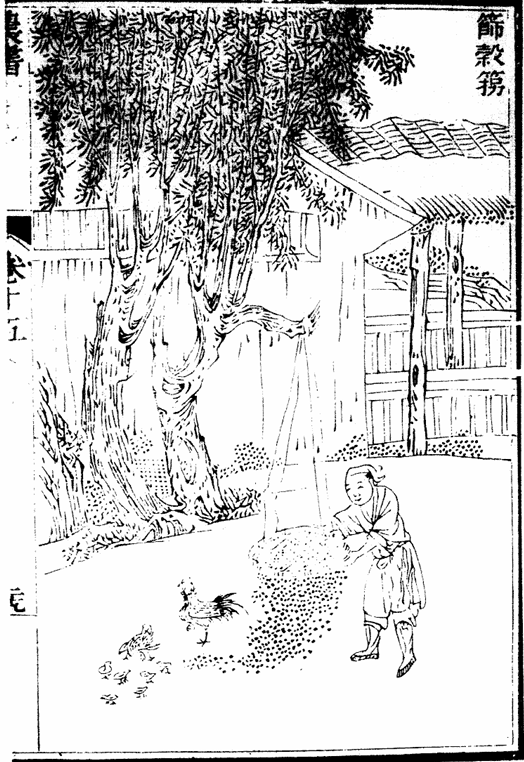
Winnowing is the process of removing the heavy grain from the chaff through manipulation. Commonly winnowing baskets or trays are used to remove chaff. Baskets and tray require dextrous movements by a rhythmic flick of the wrists the chaff is flicked off the edge of the basket and the heavy grain sticks to the bottom. Sieves or Shai were also a substitute although they took on similar forms to the baskets they would be suspended from trees and did not require hand movement. Both baskets and sieves were typically made of woven bamboo leaves.On much windier farmers might prefer to winnow the grain by tossing it either with a fork or a shovel. (Bray, 1984,363)
“Winnnowing machines” did exist during this time which were compiled of a large spinning fan like structure that could be turned by a lever. These structures could come unenclosed or enclosed, meaning a fan would be covering the fan like structure. The heavier grain would fall through an apenditure at the bottom and the lighter chaff would be blown out down a different tunnel. (Bray, 1984, 371)
To exclude this process sometimes rice may be sold off to Rice mills. The rice is then dehulled and polished at the mill ready to be sold.( Jones, 1927, 86)