
Tools/ Cutting
Rice is typically harvested around 3-6 months after being planted usually in September or October (Jones, 1927, 86). Early harvesting was typically done by hand using a variety of tools. One tool that was used to harvest rice was called the harvesting knives. Harvesting knives are typically made of stone, shell, or even pottery and much later was known to have been made out of iron. This object was hand-held and took various different shapes. Typically this object could be held in the palm of the hand with a loop of cord, leather, or metal that fingers could pass through. These knives were ideal for reaping crops that ripen uneavely. It allowed for careful inspection of each head of grain and facilitates their development and ripeness (Bray, 1984, 329). These knives have been known to be used as early as neolithic times and are still used today,
Another popular reaping tool for rice was the sickle also known as “lien”. Early sickles were known to made of stone or shell and later made of bronze or iron. Sickles took on various shapes the most popular being a balanced Sickle which would be heavily curved and set so that it extends behind the handle as well as in fron, balancing the weight around the handle so its less tiring to use (Bray, 1984, 331). Balanced Sickles are less common in China but there is no rational to explain. Unbalanced sickles were usually gently curved with a thick ridge along the back for strength and a smooth blade. The blade was typically 20-30 CM long. Sickles were used to harvest large quantities of a grain and serrated sickles were most popular to use in rice growing areas as they could could withstand this humidity in rice growing regions.
Only one mechanised reaping tool called a push-sickle (thui lien) was known to be used later own which could be associated to be a primitive lawn mower. Chinese farmer failed to develop mechanical tools for reaping. It is speculated that because terrain of fields and sizes made it unnecessary to have any sort of mechanised tools.e (Bray, 1984, 336)
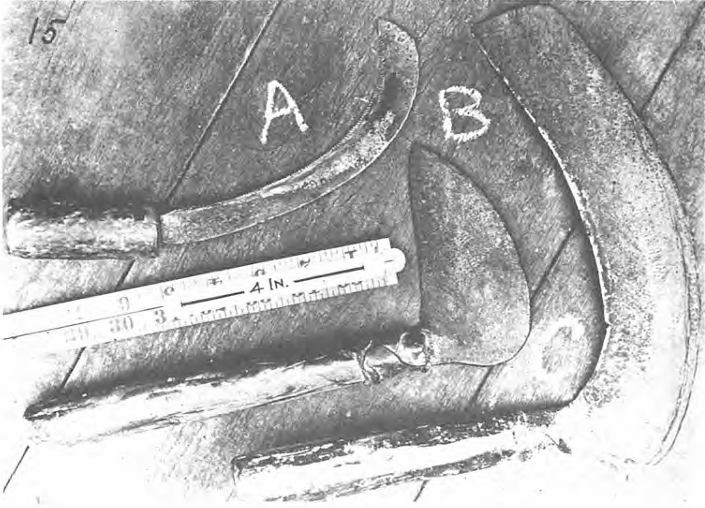
(Bray, 1984 333)
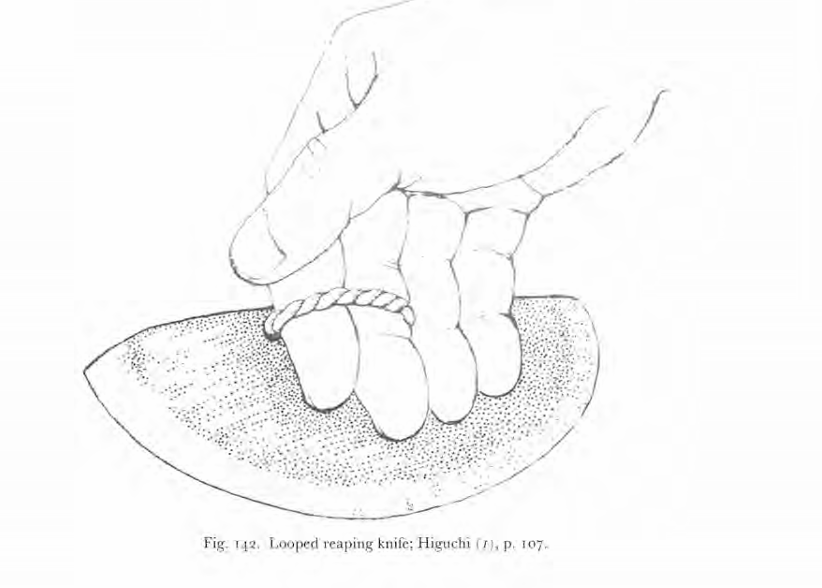
(Bray, 1984, 326)
Threshing
Before storing threshing was required to remove grain from the straw. There were a few tools used to thresh the seed which included threshing floors, tubs and sticks. Threshing floors were a more permanent structure made of a mixture of sand, lime, and cement that made it impervious to rain with proper care. To substitute permanent flooring, these floorings were substituted by a finely woven mat. Mat not only avoided grains from being contaminated with dust or sand but also prevented losses. The mat may be used for sun-drying the grains or rol,ed up to make a cylindrical basket (thun). Threshing tubs would be made out of bamboo and would be either rounded or square. (Bray,1984, 347) Threshing the seed could either be done by hand or removed by being treaded upon. Treading required the use of ones own feet, animal, or heavy roller. To be less injurious to feet grain would be treaded upon while still damp. Treading the seed was usually a womens task. Another form of threshing would be to beat out the shieves, this could either be done by hand or with the use of a flail, which would be a long wooden stick with multiple strips of wood attached to the end.
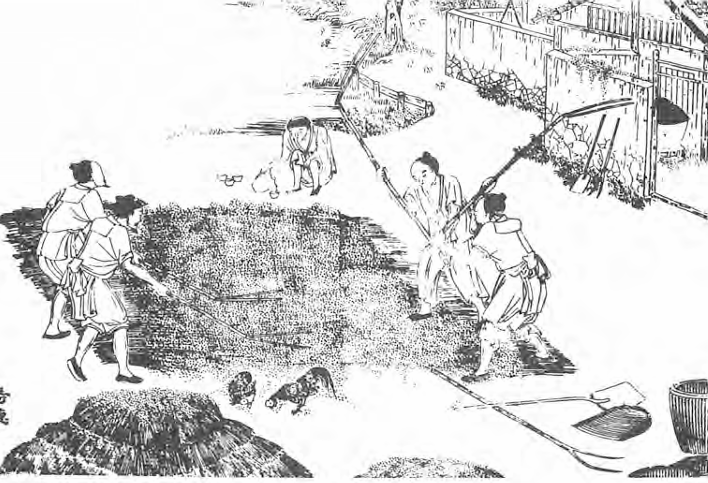
(Bray,1984, 346)
Winnowing
Winnowing is the process of removing the heavy grain from the chaff through manipulation. Commonly winnowing baskets or trays are used to remove chaff. Baskets and tray require dextrous movements by a rhythmic flick of the wrists the chaff is flicked off the edge of the basket and the heavy grain sticks to the bottom. Sieves or Shai were also a substitute although they took on similar forms to the baskets they would be suspended from trees and did not require hand movement. Both baskets and sieves were typically made of woven bamboo leaves.On much windier farmers might prefer to winnow the grain by tossing it either with a fork or a shovel. (Bray, 1984,363)
“Winnnowing machines” did exist during this time which were compiled of a large spinning fan like structure that could be turned by a lever. These structures could come unenclosed or enclosed, meaning a fan would be covering the fan like structure. The heavier grain would fall through an apenditure at the bottom and the lighter chaff would be blown out down a different tunnel. (Bray, 1984, 371)
To exclude this process sometimes rice may be sold off to Rice mills. The rice is then dehulled and polished at the mill ready to be sold.( Jones, 1927, 86)
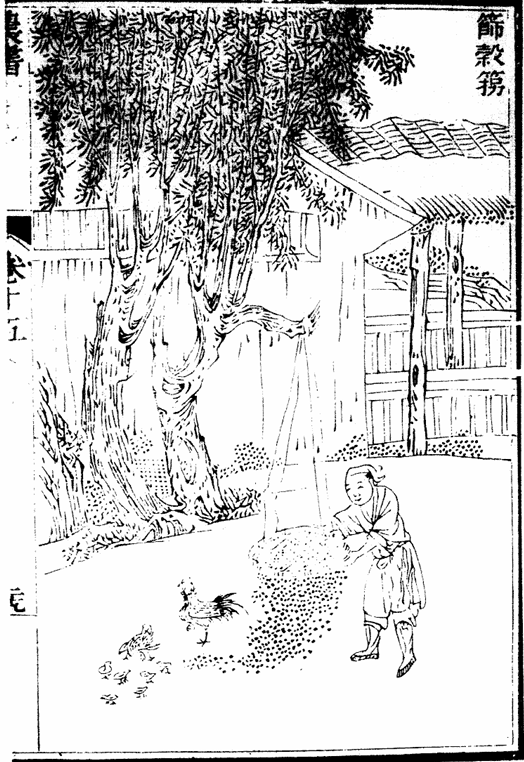
(Bray, 1984, 365)