
Sowing/Transplating

As discussed in prior sections, rice paddies often faced land constraints due to a variety of factors; be they tenant holdings of a larger estate, urban expansion, or geographic constraints; rice farmers across southern China were incentivized to maximize the productivity of each rice plant within a limited agricultural space (Marks, 1996). Transplanting thus became a key fixture of proper rice cultivation, involving meticulous attention to detail for the success of each rice plant. 

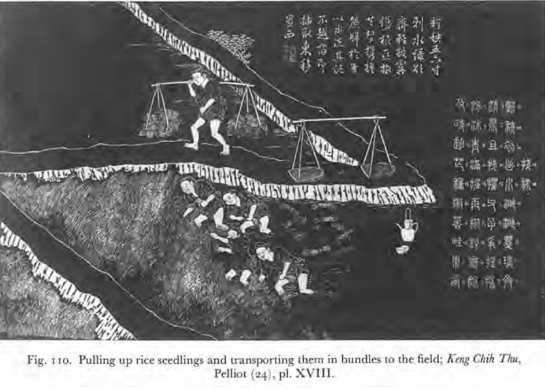
Rice stalks that had begun their growth in a designated nursery field upstream, were cut away from their roots and immediately moved to the mainfield downstream. Cuts to the stalk were made with hand-held precision to minimize any potential waste of the rice crop and match potential outputs (Bray, 1984). Cut stalks would be gathered in bamboo baskets and strung along drying racks in transition between the two fields. Once dry, they could be regathered  and planted individually into the main field. It was important to allow each rice plant additional space between each other as each rice plant would grow to meet its full potential (Hsu Kuang-Chhi, N/A).
Weeding

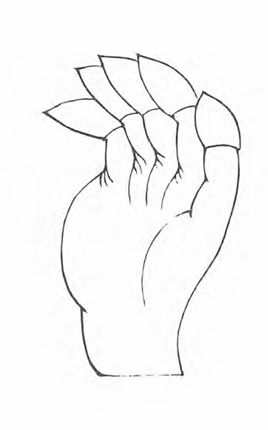
It was encouraged that rice be weeded two or three times during its growing period (Liu 1991), and when weeding the paddies, it was easy to damage the rice and lose portions of it along with the weeds if one was not careful. In order to maintain the rice’s quality and output, it was widely accepted that hand-weeding be the dominant method, as although it was back-breaking labor, with farmers having to wade on their knees in the paddies to pluck the weeds, it ensured a more bountiful harvest, letting the farmer be more thorough between each weed and grain (Bray 1984). While many farmers used their bare hands to weed the paddies, it was a long-running practice for some to use carved-bamboo weeding claws worn on the tip of each finger, providing protection as well as sharpness useful for uprooting the weeds. Although not as common of a practice, it has also been documented that some farmers were skilled enough to stand upright in the paddies and weed with their toes while holding a staff to keep themselves steady. This way, the labor was not as (literally) back-breaking. (Liu 1991) (Bray 1984, 289-318)

(Bray, 1984, 315)